
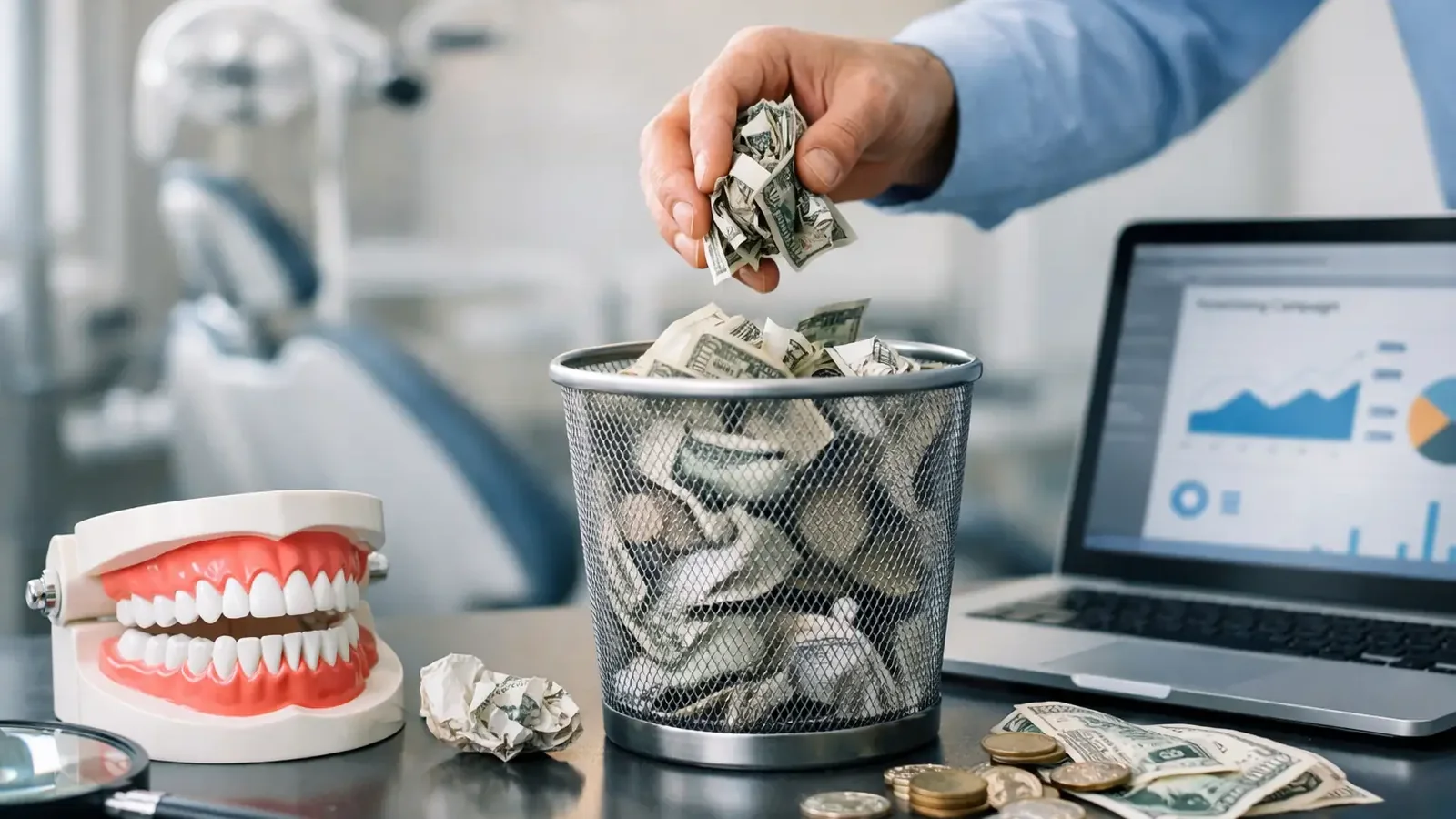
A practice spends $4,000 on ads, gets a pile of "leads," and books almost no high-value cases. Sound familiar? The problem usually is not that ads "don’t work." It’s that the campaign was built like general local advertising when the goal was elective treatment demand.
For implant and cosmetic clinics, that gap is expensive. When your ad account is optimized for low-quality clicks instead of qualified filtered patient opportunities, you can burn through budget fast and still feel like marketing is broken. This is usually why dental ads fail - not because patients are not interested, but because the strategy does not match how high-ticket dental decisions actually happen.
Why dental ads fail for implant and cosmetic clinics
Most dental advertising fails before the campaign even launches. The offer is vague, the audience is too broad, the creative looks like every other practice in town, and the landing page asks for commitment before trust is built.
That might still generate traffic. It might even generate form fills. But form fills are not the same as qualified opportunities, and qualified opportunities are not the same as treatment starts. Owners who care about ROI need to look further down the funnel.
Elective dentistry has a different buying cycle than emergency or hygiene services. A patient considering veneers or implants is weighing price, fear, time, credibility, and outcome. If your ads do not address those concerns clearly, patients will hesitate, shop around, or disappear completely.
The most common reasons dental ads fail:
The offer is too weak
"Free patient opportunity" is not a strategy. It is a default setting.
If every competitor in your market offers a free opportunity, then your ad has no real pull. High-value patients need a reason to act now and a reason to choose your clinic over the next one. That could be a clear entry point, financing emphasis, a limited treatment assessment, a smile design angle, or a message built around a specific outcome.
The trade-off here is simple. A broad offer may attract more inquiries, but lower quality. A tighter offer often reduces volume while improving intent. For most implant and cosmetic clinics, intent matters more than raw lead count.
The targeting is either too broad or too narrow
A lot of campaigns are set up with lazy local targeting. Radius around the office, broad age group, generic dental interests, done. That approach often reaches people who are unlikely to move forward with elective treatment.
On the other side, some campaigns are overbuilt. Too many filters. Too many exclusions. Audience sizes get tiny, costs rise, and delivery becomes unstable.
This is where channel matters. Meta can be excellent for generating demand if the message is strong and the creative feels native to the platform. Google is stronger when the search intent already exists. If your clinic needs immediate high-intent inquiries, Google often carries more direct purchase intent. If you want scale and lower-cost attention, Meta can work well, but only if the ad does not feel polished to the point of being ignored.
The creative looks like an ad, so people skip it
Before-and-after results matter in dentistry, but the way they are presented matters just as much. Stock-smile graphics, stiff doctor headshots, and generic office footage rarely stop the scroll.
Patients respond to specificity and realism. They want to hear concerns that sound like their own. They want to see proof that feels believable. That is why UGC-style ad creative often outperforms traditional agency-style assets for elective cases. It lowers resistance and makes the message feel less like promotion and more like a patient-centered explanation.
That does not mean every polished asset fails. It means the creative has to earn attention quickly. If the first three seconds do not make a patient feel seen, the click never happens.
The ad promises one thing and the page says another
This is one of the biggest leaks in the funnel.
A patient clicks an ad about implants, lands on a generic homepage, and has to hunt for basic information. Or they click on a cosmetic offer and hit a cluttered page with five service tabs, no financing explanation, and a long form asking for too much too soon.
The landing page has one job: continue the conversation started by the ad. Same procedure. Same pain point. Same promise. Same contact to action.
If your ad is specific and your page is generic, conversion rates will suffer. If the page is visually outdated or thin on proof, trust drops even faster.
The practice is optimizing for leads, not qualified opportunities
This is where many owners get misled by reporting.
A marketing provider says the campaign generated 67 leads at a low cost per lead. But how many answered the phone? How many were qualified? How many booked? How many showed? How many accepted treatment?
unqualified leads can be the most expensive outcome in the account.
For implant and cosmetic cases, the real KPI is not top-of-funnel activity. It is qualified filtered patient opportunities and the revenue they produce. If your campaigns are not being measured against qualified opportunities and downstream case value, you cannot judge performance accurately.
Why dental ads fail even when the agency says they are working
Some campaigns look healthy in-platform while failing in the practice.
Click-through rate can be fine. Cost per click can be reasonable. Lead volume can look impressive. But if front desk follow-up is weak, speed to contact is slow, or the leads are low intent, none of that turns into production.
This is where owners need a more disciplined view of marketing. Ad performance and operational performance are connected. A bad campaign can create bad leads, but a good campaign can also be wasted by poor intake.
That does not mean every issue is on the practice side. It means diagnosis has to be honest. If the campaign is targeting the wrong patient, no amount of phone scripting will rescue it. If the leads are solid but no one is calling them back for six hours, the ad account is not the only problem.
What a dental ad campaign needs to produce real ROI
A campaign built for elective dentistry should feel commercially tight from the first impression to the booked patient opportunity.
It starts with a procedure-specific offer. Not generic dentistry. Not "we care about your smile." Something connected to an actual patient decision. The message should speak to urgency, outcome, affordability, or confidence, depending on the procedure and market.
Then the channel has to match the goal. Google is often best for intercepting intent that already exists. Meta is often best for creating intent and retargeting interested prospects. Most clinics do not need every platform at once. They need the right one, executed well, with enough budget to gather signal.
Creative should be simple, believable, and patient-centered. In many markets, low-friction UGC-style video will outperform expensive brand pieces because it feels more trustworthy. That is especially true for patients who are skeptical, nervous, or price-conscious.
The landing page should remove doubt, not create homework. Clear treatment focus, proof, financing cues, simple forms, and one obvious next step. Anything that distracts from booking should be questioned.
And finally, reporting needs to track the numbers that matter. Not impressions. Not vanity engagement. Not raw leads. Booked patient opportunities, show rates, case acceptance, and return on ad spend.
The fix is usually simpler than owners expect
When owners ask why dental ads fail, they often expect a technical answer hidden inside the ad platform. Sometimes there is one. More often, the problem is basic: weak message, wrong audience, poor page, bad follow-up, wrong KPI.
That is also the good news. These are fixable issues.
A clinic does not need a bloated marketing stack to generate profitable elective qualified opportunities. It needs a focused system built around how implant and cosmetic patients actually choose providers. That means clear positioning, channel discipline, better creative, and measurement tied to revenue instead of activity.
At Booked.Dental, that is the standard. The goal is not to "run ads." The goal is to turn Meta and Google into a reliable source of qualified filtered patient opportunities for high-value procedures.
If your current campaigns are producing noise instead of case opportunities, do not assume your market is the problem. Most of the time, the market is there. The message just is not strong enough to convert it.
Practical takeaways
What to do with this information
Judge the strategy by qualified opportunities, not by raw clicks, impressions, or unfiltered lead volume.
Connect the channel, creative, landing page, qualification result, show rate, treatment acceptance, and ROI before scaling.
If the campaign does not teach the ad platform which prospects become real patients, budget can drift toward easy but low-quality activity.
Clinic decision checklist
Before increasing budget or changing channels, check that the system is measuring patient quality rather than marketing activity alone.
- Does the prospect show intent for a high-value treatment such as implants, full-arch care, veneers, or cosmetic dentistry?
- Is there a clear way to filter urgency, location, treatment fit, and financial fit before the team spends time?
- Can the clinic see which campaigns produced real patient opportunities rather than only form submissions?
- Does the content explain the next step in a way that reduces fear and increases trust?
Frequently asked questions
How should a clinic use this guide on Why Dental Ads Fail When They Optimize for Clicks Instead of Patients?
Use it as a decision checklist: define which treatments you want to grow, what counts as a qualified opportunity, and which metrics prove the marketing is producing real patients instead of surface-level activity.
What is the most important metric after a lead comes in?
Cost per lead is only an early signal. The clinic should track reachability, qualification, booked appointment rate, show rate, treatment acceptance, and ROI from closed cases.
Should SEO, Google Ads, and Meta Ads be measured the same way?
They should all connect back to patient quality and ROI, but they create demand differently. Google captures active searches, Meta creates demand, and SEO supports research, trust, and local authority.
Next step
Turn this into a clinic growth check
Use the most relevant service, proof example, and calculator below to decide whether this strategy fits your clinic's market.
Dental Marketing Agency
Compare dental SEO, Google Ads, lead filtering, proof, and 20x+ ROI positioning for clinics that want qualified patient opportunities.
ProofDental Lead Quality Before and After
Dental Lead Quality Before and After guidance for dental clinics that want qualified patient opportunities, cleaner tracking, and growth tied to real consults.
ResourceDental Marketing Agency Checklist
A clinic-owner checklist for choosing a dental marketing agency based on proof, tracking, lead quality, and ROI clarity.
ToolDental Lead Quality Score Calculator
Score dental leads by treatment intent, reachability, location fit, and readiness before your team spends serious follow-up time.
Ready to check if your market is available?
Submit your details to confirm whether your city is still open. Booked.Dental works with only one implant or cosmetic clinic per local market.
Check Clinic Fit