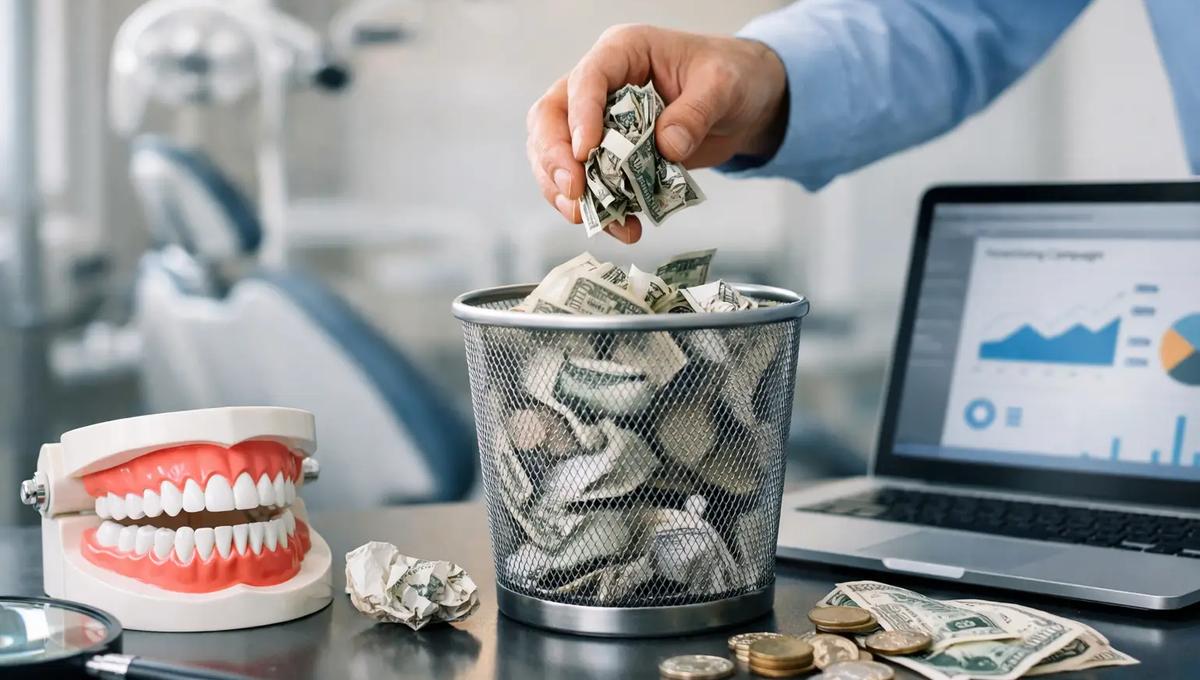
A lot of dental practices think they have an ads problem when they really have an economics problem. If you're paying for clicks, calls, and form submissions but not seeing enough high-value consults, the issue is usually not that ads "don't work." It's how dentists waste ad budget in the gaps between targeting, offer, follow-up, and conversion.
For implant and cosmetic clinics, wasted spend is rarely dramatic. It usually shows up in quieter ways - broad campaigns that attract low-intent leads, landing pages that don't move people to book, front desk delays, and ad decisions based on feelings instead of case value. Small leaks add up fast when each missed implant or veneer consult has real revenue attached to it.
Where dentists waste ad budget most often
The biggest mistake is treating all dental advertising like general awareness. That may be fine for a multi-location brand trying to stay visible, but it's expensive for a practice that needs booked consultations for implants, All-on-4, veneers, or smile makeovers.
If your campaigns are optimized for traffic, reach, or vague engagement, you're often paying platforms to find cheap attention instead of buyers. Cheap clicks can look good in a report. They do not pay for chair time.
A better question is simple: are your ads producing qualified consultation calls for profitable procedures? If not, the campaign may be active, but the budget is still being wasted.
Broad targeting brings broad problems
Many practices run ads with audience settings that are too loose because they want more volume. More volume sounds good until half the leads are price shoppers, insurance-only inquiries, or patients looking for routine cleanings.
Implant and cosmetic marketing works best when the message, audience, and offer are tightly aligned. A 55-year-old considering full-arch treatment is not responding to the same ad angle as a 28-year-old interested in veneers. When those segments get lumped together, lead quality drops and cost per booked consult climbs.
Weak offers attract weak intent
A lot of practices spend heavily on ads without giving prospects a compelling reason to take the next step now. "Book an appointment" is not a serious offer. It's a generic instruction.
For elective dentistry, the offer has to reduce friction. That might mean a free implant consultation, a cosmetic smile assessment, transparent financing messaging, or a clear explanation of candidacy. If the ad asks for action without making the value of that action obvious, response rates drop and budget gets burned.
How dentists waste ad budget after the lead comes in
This is the part that hurts the most because the ad platform gets blamed for an internal conversion issue. A lead can be expensive and still be profitable if your team contacts fast, handles objections well, and books decisively. A cheap lead is worthless if it sits untouched for six hours.
Speed matters more than most practices want to admit. High-intent prospects often submit forms to multiple providers. The first competent follow-up usually wins the conversation.
If your front desk is juggling hygiene calls, insurance questions, and surgery scheduling, ad leads can get treated like one more inbound task instead of a revenue opportunity. That alone can destroy campaign ROI.
Slow response times kill expensive leads
For high-value cases, every minute between inquiry and contact matters. Yet many clinics still call leads once, leave a voicemail, and move on. Others wait until the next morning. By then, the patient may already be booked elsewhere or mentally checked out.
If you're paying premium rates on Meta or Google for local intent, slow follow-up is one of the clearest examples of how dentists waste ad budget. You already bought the opportunity. Failing to work it properly is the expensive part.
No lead nurture means preventable loss
Not every implant or cosmetic lead books on the first call. Some need time, financing reassurance, spouse buy-in, or a second touchpoint. Practices that expect instant conversion from every inquiry usually undercount the value of proper nurturing.
Text follow-up, voicemail cadence, reactivation, and simple persistence can recover leads that would otherwise be written off as bad. That does not mean chasing everyone forever. It means having a process strong enough to separate true dead leads from leads that just need another step.
Bad measurement creates fake confidence
One reason ad waste survives so long is that many practices measure the wrong thing. They look at impressions, click-through rates, and cost per lead, then assume the account is healthy. Those numbers matter, but they are not the finish line.
For elective dental marketing, the useful metrics are closer to the money: cost per qualified consult, show rate, treatment acceptance, and revenue per booked case. A campaign that generates leads at $35 each can be worse than one at $120 each if the cheaper leads never show up or never qualify.
This is where channel choice also matters. Google Ads often captures existing demand from people actively searching for solutions. Meta can create demand and generate strong volume when the creative and targeting are right. Neither channel is automatically better. The wrong setup on either one gets expensive fast.
Good numbers can still hide wasted spend
A campaign can look efficient on paper while underperforming in reality. Maybe branded search is inflating results. Maybe existing patients are converting through retargeting and getting counted as new acquisition. Maybe staff are marking low-quality leads as "booked" before they show.
The fix is tighter attribution and harder questions. How many net new implant or cosmetic consults came from ads? How many showed up? How many started treatment? That view exposes waste quickly.
The landing page problem nobody wants to own
Many practices send paid traffic to a generic homepage and hope the website does the selling. Usually it doesn't. Homepages are built to say everything to everyone. Paid traffic needs a page built for one offer, one audience, and one action.
If your implant ad lands on a page that talks about family dentistry, insurance plans, and pediatric care before it explains implant candidacy, you've created friction. Every extra click, vague headline, and weak call to action lowers conversion.
A strong page does not need to be complicated. It needs message match, proof, simple form flow, financing clarity, and a reason to book now. That's what turns paid traffic into consultations instead of bounce rates.
Budget spread too thin is still wasted budget
Another common issue is trying to advertise every service at once on a modest budget. Whitening, Invisalign, implants, emergency, veneers, sleep apnea - all active, none funded enough to learn or scale.
That approach feels diversified, but it usually creates weak data and inconsistent outcomes. For most growth-minded practices, concentrating budget on the highest-margin procedures makes more sense. One strong implant campaign will often outperform six underfunded campaigns fighting for attention.
This is especially true if your goal is predictable revenue, not just more activity. Elective case acquisition is about profitable concentration, not marketing variety for its own sake.
What to fix first if your ads feel expensive
Start with the offer. If the offer is weak, better targeting will not save it. Then check where leads are going and how fast your team responds. After that, look at whether your campaigns are actually aimed at qualified consults rather than cheap lead volume.
You should also separate channel expectations. Google should capture intent already in market. Meta should create demand and convert attention with the right creative, often UGC-style ads that feel credible instead of overproduced. Both can work well for implant and cosmetic clinics, but only when the funnel behind them is built to convert.
If you want a useful benchmark, ask whether your current setup can produce first consults quickly enough to justify continued spend. If the answer is no, keep the budget small until the system improves. Scaling inefficiency just buys more inefficiency.
Booked.Dental focuses on this exact issue for implant and cosmetic clinics because the win is rarely "more marketing." The win is a tighter patient acquisition system that turns ad spend into qualified consultation calls without the usual waste.
The clinics that win with ads are not always the ones spending the most. They're the ones removing friction from click to consult, measuring what matters, and staying focused on case value over vanity metrics. That's where ad budget stops disappearing and starts producing growth.
Ready to check if your market is available?
Pick a time to confirm whether your city is still open. Booked.Dental works with only one implant or cosmetic clinic per local market.
Check Your Market